The global electric vehicle sector is undergoing a massive transformation. Battery management systems (BMS) serve as the critical intelligence layer for these vehicles. As adoption increases, researchers are turning to artificial intelligence to solve complex performance challenges [1].
Traditional BMS architectures often rely on static lookup tables and predefined algorithms. These methods frequently struggle to account for the dynamic nature of battery aging and real-world driving conditions [2]. By integrating AI-driven BMS solutions, engineers can now achieve higher precision in monitoring and control.
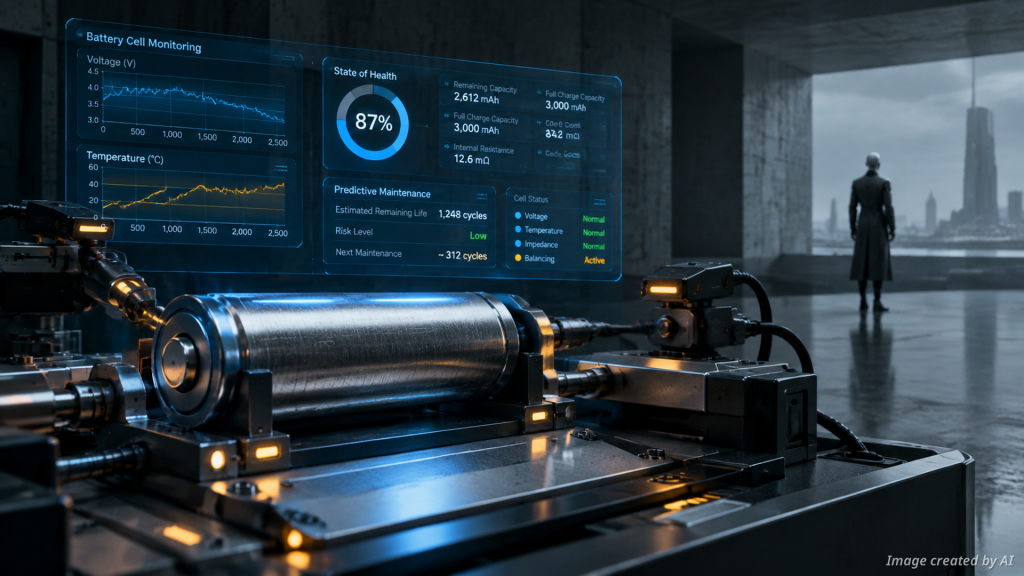
Why AI is essential for next-generation batteries
The shift toward intelligent BMS is driven by the need for safer and more efficient energy storage. AI algorithms excel at processing massive datasets from onboard sensors. These systems provide real-time insights that were previously impossible to capture [4].
Researchers are currently focusing on three primary areas for AI integration:
- State of health (SOH) estimation
- State of charge (SOC) prediction
- Remaining useful life (RUL) forecasting
These capabilities are vital for Edge AI in electric vehicles, where local processing power must make split-second decisions. By leveraging machine learning, vehicles can adapt their charging patterns to extend overall battery longevity [1].
Predictive maintenance and safety
Safety remains the highest priority for automotive battery researchers. AI models, such as recurrent neural networks and Long Short-Term Memory (LSTM) models, offer superior performance in detecting anomalies [4]. These models identify early indicators of thermal runaway or mechanical stress long before a failure occurs.
The integration of advanced algorithms ensures that safety compliance meets increasingly stringent global standards, such as ISO 26262 [1]. Predictive maintenance allows manufacturers to move away from reactive repairs. Instead, they can provide proactive updates that optimize the battery's operating environment.
Hybrid models for complex environments
Many researchers are now adopting hybrid AI-based battery management systems (HAI-BMS). These systems combine conventional physical models with neural networks [4]. This approach provides the stability of traditional physics-based simulations while gaining the predictive power of machine learning.
For instance, a hybrid model might use a feedforward neural network to estimate capacity under load. Simultaneously, it uses random forest algorithms to filter out sensor noise. This multi-layered approach is essential for handling the complex challenges of capacity fade and thermal degradation [5].
Bi-directional energy exchange and the grid
The role of the BMS is expanding beyond the vehicle itself. As vehicle-to-grid (V2G) technology matures, the BMS must manage bi-directional energy flows [5]. AI helps determine the optimal moments to charge or discharge power based on grid stability and energy costs.
This intelligent orchestration turns the EV into a mobile energy asset. It also requires the BMS to be highly aware of the battery's current state of health to prevent excessive degradation during grid support activities. AI-driven systems are uniquely positioned to balance these conflicting demands [2].
Market growth and future outlook
The market for intelligent battery management is expanding rapidly. Projections indicate the sector will reach significant valuations by 2033, driven by the sustained global expansion of electric vehicles [1]. Researchers play a pivotal role in this growth by refining the models that power these systems.
As we look forward, the integration of AI into BMS architectures will become standard. Ongoing research into multiphysics frameworks will further improve the accuracy of these systems [5]. The ultimate goal is to create batteries that are not only safer but also more sustainable over their entire lifecycle.
More Information
- State of health (SOH): A metric representing the current condition of a battery compared to its original capacity, crucial for determining the remaining lifespan and reliability of EV power storage systems.
- Thermal runaway: A dangerous chain reaction within a battery cell where an increase in temperature causes a further increase in temperature, potentially leading to fire or catastrophic failure.
- Long Short-Term Memory (LSTM): A type of recurrent neural network architecture capable of learning long-term dependencies, widely used in predictive modeling for battery degradation and remaining useful life estimation.
- Vehicle-to-grid (V2G): A system where electric vehicles communicate with the power grid to sell demand response services by returning electricity to the grid or by throttling their charging rate.
- Multiphysics framework: A computational approach that simulates multiple interacting physical phenomena, such as thermal, electrical, and mechanical stress, to provide a comprehensive view of battery performance.