The automotive landscape is undergoing a massive transformation. As software-defined vehicles become the industry standard, human-machine interface (HMI) designers face new challenges. Gesture control technology is rapidly emerging as a critical component in this evolution [1].
Electric vehicles (EVs) offer unique opportunities for advanced cabin design. These vehicles feature larger central displays and integrated digital cockpits that invite innovation [1]. By moving beyond traditional touchscreens, designers can create more intuitive, safer, and cleaner user experiences.
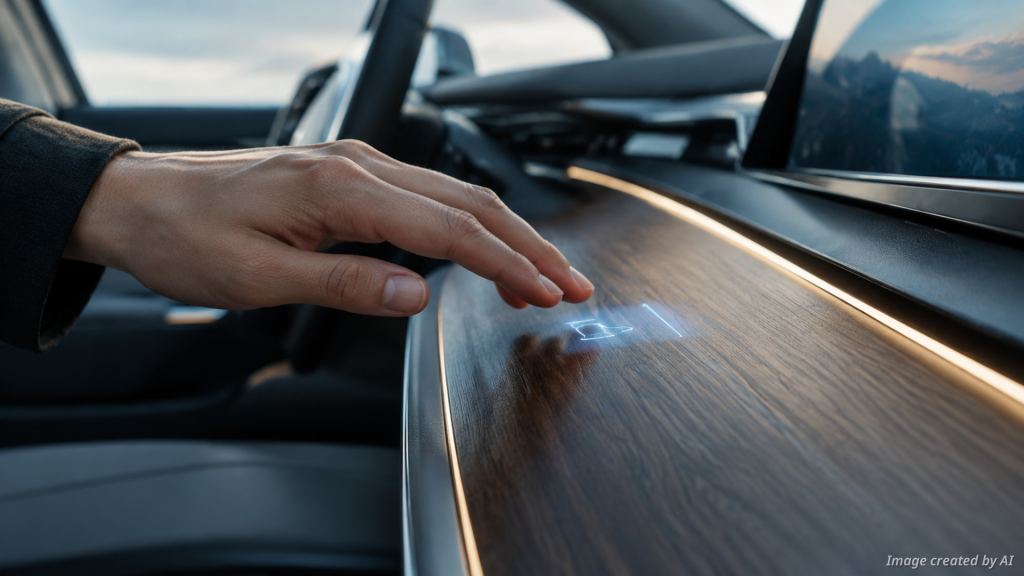
The rise of touchless interaction
Gesture recognition allows drivers to interact with their vehicles without physical contact. This technology is not just a gimmick; it addresses real-world safety concerns. By reducing the need to look at a screen, drivers can keep their eyes on the road [4]. This shift is essential as gesture recognition technology continues to grow at a CAGR of 22.5% through 2032 [4].
Major manufacturers are already leading this charge. Companies like Volkswagen, BMW, and Mercedes-Benz have integrated these systems into their latest models [4]. These brands recognize that the future of driving involves seamless connectivity between the user and the machine [2].
Why gesture control matters for HMI designers
For HMI designers, the goal is to reduce cognitive load. A well-designed gesture system feels natural and immediate. It should not require a manual to understand. Designers must consider the ergonomics of the cabin space carefully.
The architecture and engineering of EV voice command interfaces often work in tandem with gesture systems. When combined, these modalities create a multimodal HMI that is highly responsive. This approach ensures that the driver remains in control while minimizing distractions [1].
Regulatory drivers and market growth
Safety regulations are pushing this technology forward. For instance, the European Union's General Safety Regulation now mandates in-cabin monitoring systems for new vehicles [1]. This creates a structural tailwind for the adoption of sensors that support both driver monitoring and gesture recognition [1].
The automotive gesture recognition systems market is projected to reach significant valuations in the coming years [1]. As sensor technology becomes more precise, the latency of these systems drops significantly. This makes the interaction feel more like a physical button press than a delayed digital response.
Challenges in implementation
Despite the potential, implementation is difficult. False positives remain a significant hurdle for designers. A driver waving their hand while talking to a passenger should not accidentally change the radio station or unlock the car [3].
Designers must implement robust filtering algorithms. Context-awareness is key to solving this problem. The system must understand when a gesture is intentional versus incidental. This requires deep integration between the sensor hardware and the HMI software stack [5].
Designing for the future
The next generation of EVs will likely feature "smart" surfaces. These surfaces can detect proximity and gestures even when they are not active displays. This allows for a cleaner, minimalist aesthetic that is highly sought after in modern EV design.
As the future of hyper personalization in the electric vehicle market unfolds, gesture profiles will become standard. Each driver will have their own set of custom gestures. This level of personalization makes the vehicle feel like a personal assistant rather than just a mode of transport.
Best practices for HMI teams
To succeed, HMI teams should follow these core principles:
- Keep gestures simple: use intuitive movements like swipes or circular motions.
- Provide feedback: ensure the system acknowledges the gesture with a subtle visual or haptic cue.
- Prioritize safety: ensure that gesture controls never override essential vehicle safety functions.
- Test in diverse environments: ensure the sensors perform well in varying light conditions.
The automotive industry is in a state of rapid flux. By embracing gesture control, designers can help define the next era of mobility. The technology is already here, and the market is ready for innovation [4]. It is time for HMI designers to lead the way.
More Information
- Gesture recognition: A technology that uses sensors to interpret human hand or body movements as commands, allowing users to interact with digital systems without physical contact or input devices.
- HMI (Human-Machine Interface): The point of interaction between a human and a machine, encompassing the displays, controls, and software that allow users to operate and monitor vehicle systems.
- Sensor fusion: The process of combining data from multiple sensors, such as cameras and radar, to create a more accurate and reliable understanding of the environment or user intent.
- Multimodal interface: An interaction design approach that allows users to communicate with a system through multiple modes, such as voice, touch, gestures, and eye tracking, simultaneously.
- Software-defined vehicle: A vehicle whose features and functions are primarily enabled or managed through software, allowing for continuous updates and personalized user experiences over time.