Autonomous racing is rapidly transforming from a futuristic concept into a high-stakes engineering reality. By removing the human driver and replacing them with sophisticated software, developers are pushing the boundaries of machine perception and control [4].
This evolution is not merely about speed. It serves as a rigorous testing ground for the safety and performance systems that will eventually define the future of mobility [1]. As A2RL continues to showcase, real-time decision-making at high speeds is the ultimate challenge for artificial intelligence [5].
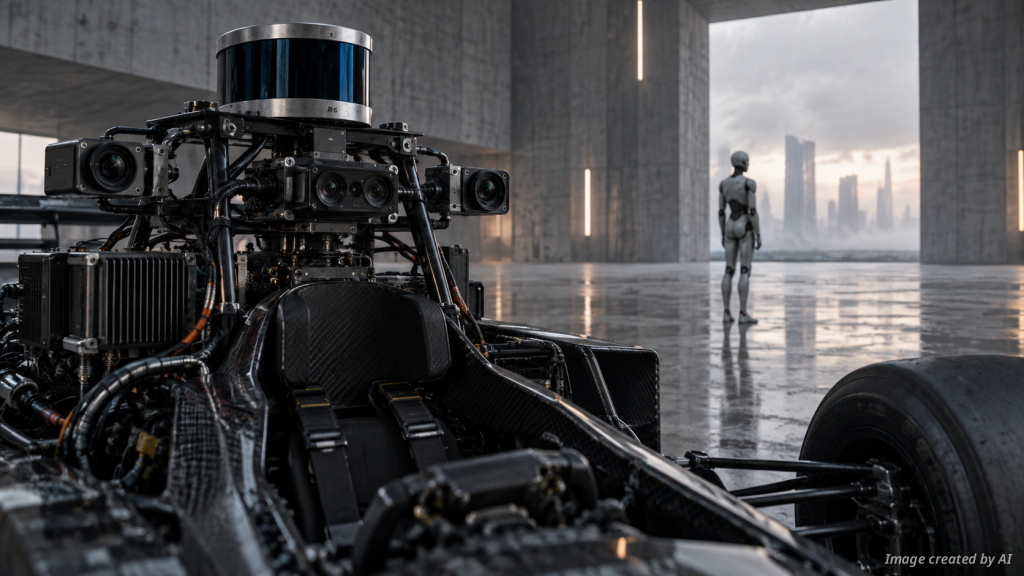
The engineering challenge of autonomous speed
Autonomous racing requires a complex integration of hardware and software. The vehicle relies on an array of sensors that act as its eyes and ears, feeding data to planning algorithms [4]. These systems must interpret the environment and make split-second decisions to maintain track position.
Researchers supported by the National Science Foundation are utilizing these high-pressure environments to accelerate AI development [2]. The goal is to bridge the gap between controlled simulations and unpredictable, real-world driving conditions.
Setting new benchmarks
History was made recently when an autonomous vehicle outperformed a human driver on a professional track [1]. This milestone proves that AI can handle the extreme dynamics of competitive racing. It challenges the long-held belief that certain tasks remain exclusively within the human domain [1].
Competitions like the Indy Autonomous Challenge provide the platform for these breakthroughs [1]. University teams from around the world compete to refine their algorithms in a high-speed, data-rich environment [1].
Professionalizing the sport
The emergence of professional teams marks a turning point for the industry. Code19 Racing stands as the world's first professional autonomous motorsports team [3]. They operate a physical AI lab where partners can deploy and test new capabilities at speed [3].
This professional approach allows for rapid model refinement. By turning the track into a data environment, teams can optimize their deployment pipelines more effectively than ever before [3]. For those interested in the broader automotive landscape, the role of AI for EV production lines remains a critical parallel development.
The future of mobility
The lessons learned on the track have direct implications for consumer safety. Autonomous racing acts as a crucible for innovation, forcing engineers to solve for reliability under extreme stress [5]. As these systems mature, they will likely transition into commercial autonomous vehicle applications.
Furthermore, the industry is increasingly focused on predictive traffic management: a new era for urban mobility. By perfecting AI decision-making at 200 mph, we gain insights that make everyday driving safer and more efficient. The synergy between racing and commercial development is stronger than ever.
Key takeaways for innovators
Innovation in this space is driven by a few core principles:
- Real-time data processing is essential for high-speed decision-making.
- Physical labs allow for faster iteration than pure software simulation.
- Cross-industry partnerships are vital for translating track insights into commercial products.
- University-led initiatives continue to be a primary source of talent and research.
The intersection of artificial intelligence and professional racing is creating a new paradigm. As we look toward the next season of racing, the focus remains on pushing the limits of what machines can achieve. The future of autonomous driving is being written on the track today.
More Information
- Indy Autonomous Challenge [1]: A global university competition that advances autonomous technologies through high-speed racing, serving as a platform for real-world validation of physical AI systems.
- National Science Foundation [2]: A U.S. government agency supporting fundamental research and education in all the non-medical fields of science and engineering, including advanced AI applications in mobility.
- Code19 Racing [3]: Recognized as the world's first professional autonomous motorsports team, operating a physical AI lab to test and refine autonomous vehicle capabilities at high speeds.
- Purdue AI Racing [4]: An engineering initiative at Purdue University that focuses on the complex mechatronic and algorithmic challenges of developing autonomous, driverless race cars.
- A2RL [5]: The Abu Dhabi Autonomous Racing League, a global platform that unites researchers and engineers to solve real-world mobility challenges through extreme autonomous competition.