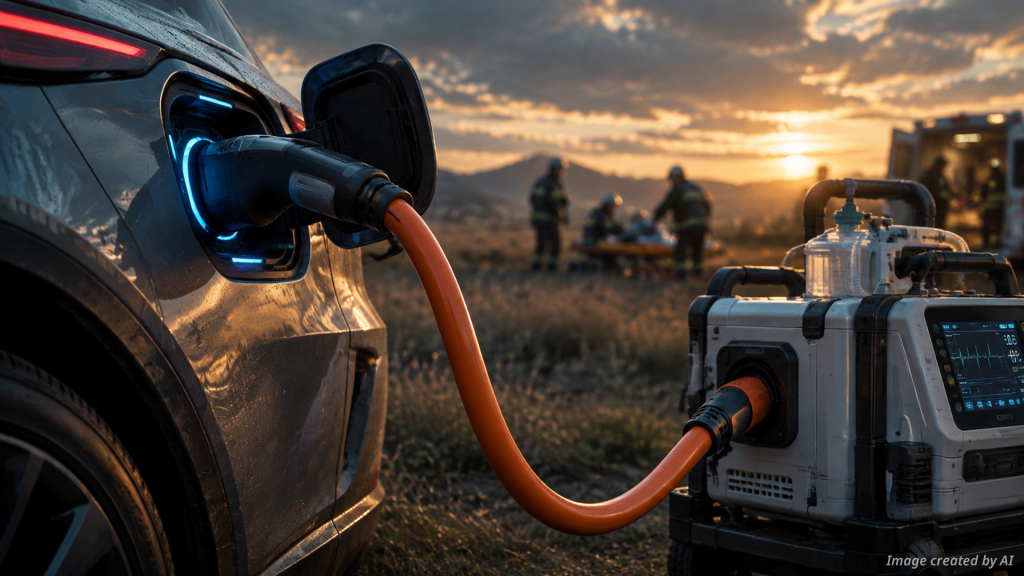
Modern emergency services rely heavily on portable energy to maintain operations during critical incidents. As global infrastructure faces increasing pressure, the electric vehicle (EV) is emerging as a vital mobile energy resource. By leveraging advanced battery technology, these vehicles function as more than just transportation; they act as mobile power banks for first responders [5].
The concept of vehicle-to-grid (V2G) technology allows energy to be pushed back from the EV battery to the power grid or specific equipment [2]. This capability transforms the traditional fleet into a distributed energy network. Emergency responders can utilize this V2G technology to stabilize power in disaster zones where the primary grid has failed.
Understanding the mobile energy revolution
Electric cars remain stationary for approximately 95 percent of the time [3]. This idle time represents a massive, untapped potential for emergency management. Instead of sitting dormant, these batteries can provide essential power to field hospitals, communication arrays, and lighting systems.
The Global EV Data Explorer highlights how rapidly the adoption of electric mobility is scaling worldwide [1]. As fleets transition to electric models, the aggregate capacity of these batteries becomes a significant strategic asset. Emergency services can integrate this capacity into their contingency planning.
The mechanics of vehicle-to-grid technology
V2G technology enables a two-way flow of electricity between the vehicle and an external load [2]. When integrated with smart software, the system intelligently manages energy discharge. This ensures that emergency vehicles maintain enough charge for transport while providing surplus power for auxiliary equipment.
By using V2G systems, departments can reduce their reliance on noisy, fuel-heavy generators. This transition promotes a cleaner, quieter, and more sustainable operational environment. It also simplifies logistics by reducing the need for bulk fuel transport in remote areas.
Enhancing grid resilience during crises
Emergency services often operate in environments where power stability is compromised. By acting as a mobile power bank, an EV can help balance local grid demand [4]. This helps prevent total system failure during peak load events caused by natural disasters.
The electric vehicles and renewable energy systems synergy is particularly powerful. Responders can charge their vehicles using renewable sources like solar or wind. They then deploy this stored clean energy exactly where it is needed most.
Portable charging solutions for field operations
Not every situation requires a full V2G setup. Portable EV charging solutions, often referred to as power banks for EVs, provide an extra layer of security [4]. These devices allow responders to provide a quick boost to vehicles that have depleted their charge in the field.
These units function similarly to small power banks for smartphones but on a much larger scale [5]. They ensure that mission-critical vehicles remain operational throughout long-duration events. This flexibility is essential for electric vehicles and smart cities for green transportation initiatives.
Strategic advantages for emergency departments
Adopting EV power bank technology offers several long-term benefits for public safety organizations:
- Reduced operational costs through intelligent energy management [4].
- Improved disaster response capabilities by creating mobile microgrids.
- Lower carbon footprints, aligning with global climate goals [1].
- Enhanced reliability by eliminating dependence on external fuel supply chains.
Departments should begin assessing their current fleet's compatibility with bidirectional charging. Early investment in this infrastructure will pay dividends as the technology becomes the global standard. The transition is not just about replacing engines; it is about reimagining the vehicle as a multi-purpose tool.
Future outlook for mobile energy storage
Projections suggest that by 2030, millions of EVs will be on the road, creating a massive distributed energy network [2]. This trend will fundamentally change how emergency services approach power supply. The ability to tap into this network will provide unprecedented flexibility during large-scale emergencies.
As battery chemistry improves, the capacity and discharge rates of these vehicles will increase. This will allow for even more intensive use of EVs as primary power sources for emergency equipment. The future of emergency response is electric, mobile, and interconnected.
More Information
- Global EV Data Explorer [1]: A comprehensive digital tool provided by the IEA that tracks historical and projected data on electric vehicle sales, charging infrastructure, and energy usage across global markets.
- Vehicle-to-grid (V2G) [2]: A technology that enables a bidirectional flow of electricity, allowing electric vehicles to store energy and discharge it back into the power grid or to external devices when needed.
- Stationary time [3]: The duration during which a vehicle is parked or not in use; for most private and commercial vehicles, this accounts for approximately 95 percent of their total lifespan.
- Grid resilience [4]: The ability of an electrical power system to withstand and recover from disruptions, often improved by balancing energy loads through distributed resources like electric vehicle batteries.
- Power bank [5]: A portable energy storage device, ranging from small handheld units for mobile phones to large-scale systems capable of providing emergency power to vehicles or critical electronic equipment.