The automotive industry is undergoing a fundamental shift toward electrification. Engineers now prioritize modular architectures to manage complexity and reduce costs. By integrating artificial intelligence, these platforms become more than just hardware; they evolve into intelligent, adaptable foundations for future mobility [1].
Modular electric vehicle (EV) platforms leverage AI to streamline design and manufacturing processes. This approach allows manufacturers to scale production across diverse vehicle segments efficiently [5].
Defining modular EV architectures
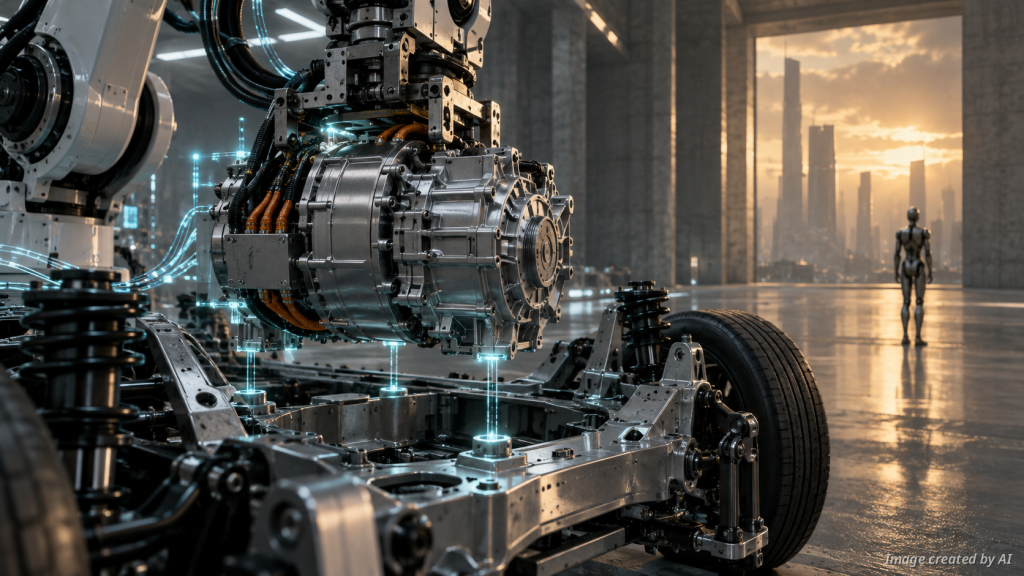
A modular platform functions as a shared foundation for multiple vehicle models. It typically includes the battery, motor, and power electric systems in a scalable layout [2]. Engineers use this structure to minimize development time for new models.
Dedicated platforms, such as the Electric-Global Modular Platform (E-GMP), represent a departure from internal combustion engine designs [2]. These platforms offer a flat floor and flexible wheelbase, which creates significant interior space for passengers [3].
The integration of AI in platform development
AI acts as a catalyst for innovation within these modular systems. By utilizing cyberinfrastructure-based frameworks, engineers can achieve criteria-dependent customization for various components [1]. This ensures that each vehicle meets specific market demands without requiring a complete redesign of the base architecture.
Machine learning algorithms analyze vast datasets to predict performance outcomes. These insights help engineers optimize battery placement and motor efficiency. Consequently, the AI-driven design process reduces the total cost of ownership while maximizing vehicle performance.
Scalability and market adaptability
Global automotive manufacturers must address varying regional requirements. Scalable architectures allow companies to adjust vehicle dimensions and powertrains quickly [5]. This flexibility is essential for maintaining a competitive edge in a rapidly changing market.
Stellantis, for example, utilizes the STLA One platform to consolidate multiple previous architectures into a single, efficient design [5]. This strategy simplifies the supply chain and allows for faster deployment of new technologies across different segments [5].
Software-defined vehicles and AI
The future of automotive engineering lies in the software-defined vehicle (SDV). AI-centric platforms, such as the EV.OS initiative, combine hardware and software to create a unified ecosystem [4]. This integration allows for continuous updates and feature enhancements after the vehicle leaves the factory.
By partnering with software experts, manufacturers can accelerate the commoditization of mobility solutions [4]. These platforms provide a reference architecture that simplifies the development of advanced driver-assistance systems (ADAS) and connectivity features [4].
Benefits of AI-enhanced modularity
Engineers gain several strategic advantages by adopting AI within modular EV platforms:
- Reduced development cycles through automated simulation and testing.
- Improved component sharing across diverse vehicle lineups.
- Enhanced flexibility to adapt to evolving battery chemistries and motor technologies.
- Optimized energy management systems that extend vehicle range.
Challenges in implementation
Despite the clear benefits, integrating AI into hardware platforms presents challenges. Data security remains a top priority for automotive engineers. Protecting the integrity of the software-defined architecture requires robust cybersecurity measures [4].
Furthermore, maintaining compatibility between legacy systems and new AI modules requires careful planning. Engineers must ensure that modular interfaces remain consistent over time. This consistency is vital for long-term scalability and hardware upgrades.
Future outlook for EV platforms
The convergence of AI and modular hardware will continue to redefine automotive manufacturing. As companies strive for carbon neutrality, AI will play a critical role in optimizing resource usage throughout the vehicle lifecycle. This includes everything from material selection to end-of-life battery recycling.
The industry is moving toward a model where the platform is a living asset. Through over-the-air updates and AI-driven performance tuning, vehicles will remain relevant for longer durations. This evolution marks a significant milestone in the transition to sustainable, intelligent transportation.
More Information
- Modular EV platform: A scalable vehicle architecture designed to support multiple models, sharing core components like the battery, chassis, and electric drive units to reduce production costs and complexity [2].
- Software-defined vehicle (SDV): A vehicle where the features and functions are primarily enabled or managed through software, allowing for continuous updates and performance improvements over the vehicle's lifespan [4].
- Cyberinfrastructure: A digital framework that supports advanced research and engineering, enabling the integration of AI and data analytics to optimize the design of complex modular systems [1].
- Electric drive module (EDM): A compact, integrated unit containing the electric motor, transmission, and power electronics, which serves as the primary propulsion component in modern modular EV platforms [5].
- Criteria-dependent customization: The process of using AI algorithms to tailor specific vehicle components or designs based on predefined performance or market requirements, ensuring optimal efficiency [1].