Traffic in major urban centers like Hanoi and Ho Chi Minh City is under immense pressure. The rapidly increasing density of personal vehicles makes commuting a daily nightmare. Artificial Intelligence (AI) is emerging as a breakthrough solution to address this challenge.
For ride-hailing drivers and daily commuters, applying AI is no longer just a trend. It is a practical tool that helps save time and fuel efficiently [3]. Let’s explore how this technology is transforming your travel routes.
Current traffic situation and the need for technology application
Road infrastructure in Vietnam currently struggles to keep pace with the growth of motorcycles and cars. Prolonged congestion causes massive economic losses every year. Drivers frequently face stress when trying to navigate during peak hours.
Transitioning to an Intelligent Transport System (ITS) is an urgent necessity. Management agencies are actively applying artificial intelligence to solve urban problems [2]. This technology helps optimize traffic flow instead of relying on manual coordination as in the past.
Core AI technologies in transportation
AI is not just an abstract concept; it is realized through various technologies. Below are applications that are changing how we travel every day.
Computer vision and AI cameras
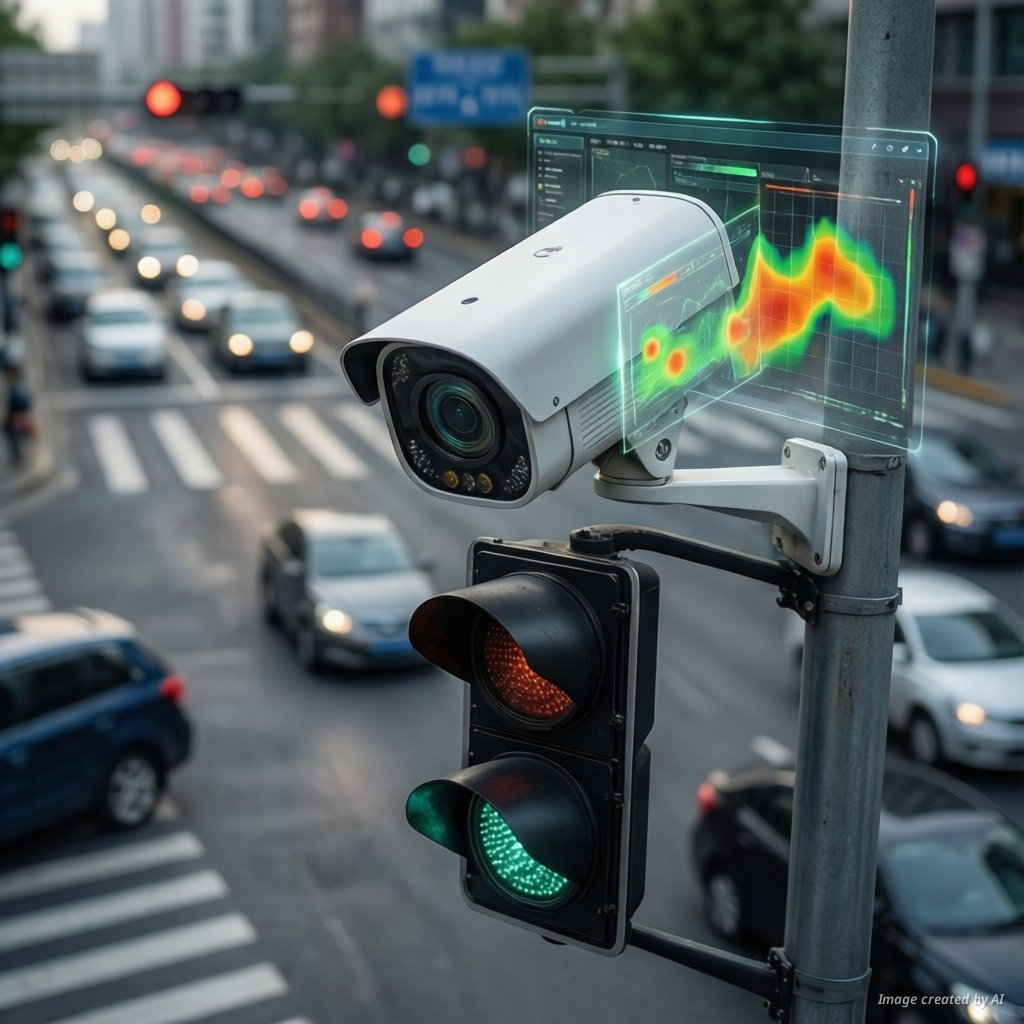
AI cameras act as the "eyes" of the traffic system. They collect real-time vehicle density data at hotspots. As a result, the system can detect collisions or traffic incidents in just a few seconds [4].
Adaptive traffic lights
Instead of using fixed timers, smart traffic lights automatically adjust their green-red cycles. This system is based on actual traffic volume at the intersection [1]. This significantly reduces waiting times for road users.
Route optimization algorithms
Applications like Grab or Be have integrated AI to suggest smart routes for drivers. Algorithms analyze historical data combined with weather conditions to forecast traffic jams. You can learn more about ADAS advanced driver assistance systems to improve safety for new drivers for a better travel experience.
Practical implementation in Vietnam
In Ho Chi Minh City, the traffic management center has connected over 1,000 AI-integrated cameras. Corridors such as Vo Van Kiet - Mai Chi Tho have successfully implemented adaptive traffic signals [1]. Results show that waiting times at intersections have decreased by 10% to 25%.
Hanoi is also striving to digitize traffic maps through its smart city project. Major arterial roads like Nguyen Trai have been equipped with cameras for license plate scanning and traffic monitoring. The application of AI to solve traffic congestion is yielding positive signals [3].
Benefits for drivers and commuters
For ride-hailing drivers, AI is a powerful "assistant" that helps optimize income. Avoiding traffic jams allows drivers to complete more orders in less time. Furthermore, choosing smart routes also helps save significantly on fuel.
Daily commuters also benefit from reduced travel times. You will feel less tired when not stuck in traffic. Additionally, AI-powered smart car maintenance prediction: the future of automotive services in Vietnam also helps you be more proactive in caring for your personal vehicle.
Challenges in implementation
Despite the many benefits, applying AI in Vietnam still faces numerous difficulties. The unique mixed traffic environment, where motorcycles make up the majority, makes recognition algorithms more complex [3]. Furthermore, data synchronization between localities is not yet fully unified.
The initial investment cost for hardware infrastructure is also a major barrier. However, with technological advancements, domestic solutions from companies like VinAI or FPT are gradually optimizing costs. This promises a smarter future of transportation for everyone [4].
The future of smart transportation
In the near future, the combination of AI and big data will create highly accurate real-time traffic maps. Vehicles will be able to communicate with each other to avoid collisions. This will not only help reduce congestion but also increase safety for road users.
The application of AI in traffic management will soon become the standard in major cities [4]. Drivers need to get accustomed to using technological applications to maximize these benefits.
Conclusion
AI in route optimization is no longer a story of the distant future. It is present and making life easier for drivers and commuters every day. By leveraging smart applications, we can contribute to reducing congestion and protecting the environment [2].
Start experiencing the convenience of technology today. A small change in how you choose your route will bring significant efficiency to your journey.
More Information
- Smart traffic lights [1]: A traffic signal control system that automatically adjusts green-red durations based on real-time vehicle volume at intersections to optimize traffic flow.
- Intelligent Transport System (ITS) [2]: A system applying information technology and AI to manage and operate traffic, helping to improve safety and travel efficiency in urban areas.
- Route optimization algorithm [3]: Complex mathematical formulas used by AI to analyze traffic data, thereby suggesting the fastest and least congested path for drivers.
- Computer vision [4]: Technology that allows computers to "see" and analyze images from traffic cameras, helping to identify vehicle density and detect accidents in a timely manner.
- Big Data [5]: Massive collections of data regarding traffic volume, weather, and driving behavior, analyzed by AI to predict potential traffic congestion points.