The automotive industry is undergoing a seismic shift as electric vehicles (EVs) take center stage. Manufacturing engineers and designers now face the challenge of creating lighter, more efficient, and highly customized components. Additive manufacturing, or 3D printing, has emerged as the critical enabler for this transition [2].
Flexible production systems allow manufacturers to adapt quickly to evolving market demands. By integrating 3D printing with advanced robotics, companies can streamline their assembly lines and reduce material waste [1]. This synergy is essential for maintaining a competitive edge in the global automotive manufacturing market.
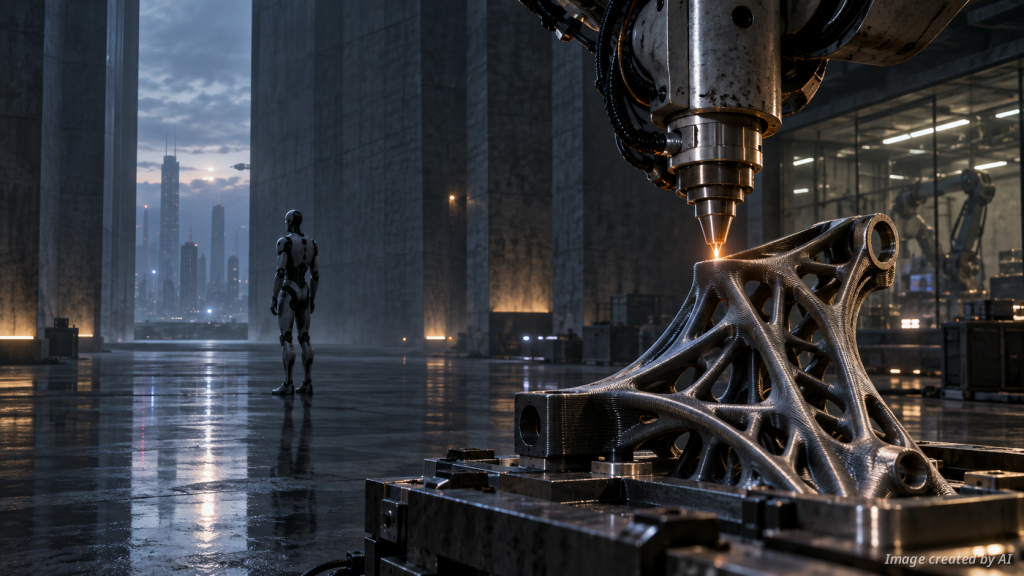
The role of additive manufacturing in EV design
Designers are no longer constrained by traditional subtractive manufacturing methods. 3D printing enables the creation of complex geometries that were previously impossible to produce [2]. These intricate structures often result in significant weight reduction, which is vital for extending the range of battery-powered vehicles. Furthermore, optimizing mechanical parts through generative design software allows engineers to maximize strength while minimizing material usage [5].
Prototyping has also become faster and more cost-effective. Engineers can iterate designs in hours rather than weeks, accelerating the development cycle for new EV models. This agility is a key advantage for companies looking to stay ahead in a rapidly changing industry [4].
Automating the flexible production line
Flexible manufacturing requires seamless integration between hardware and software. Modern automation solutions allow factories to produce different vehicle models on the same assembly line [1]. Collaborative robots, or cobots, work alongside human operators to ensure precision during the assembly of sensitive electronic components [1].
This level of automation is not just for large-scale production. It also supports small-batch manufacturing, which is increasingly important for niche EV markets. By utilizing the role of AI for EV production lines, manufacturers can predict maintenance needs and optimize workflows in real-time [4].
Material innovation and safety standards
Safety remains the top priority for automotive engineers. EVs require specialized body structures that can withstand rigorous crash tests [1]. 3D printing allows for the integration of advanced, high-strength materials that improve structural integrity. In some experimental cases, entire vehicle bodies have been produced using additive manufacturing techniques [3].
These innovations contribute to a more resilient supply chain. By localizing production through 3D printing, companies can reduce their dependence on long-distance logistics [4]. This shift towards localized, automated manufacturing is a cornerstone of the industry 4.0 revolution [4].
Future trends in automotive manufacturing
The future of vehicle production lies in the convergence of digital design and physical fabrication. As 3D printing technology matures, we will likely see more functional parts being printed directly on the assembly line. This will further reduce the need for large inventories and heavy tooling [2].
Engineers must continue to develop skills in both mechanical design and digital manufacturing. The ability to leverage high-tech production tools will define the next generation of industry leaders [4]. Companies that embrace these technologies will find themselves better positioned to meet the demands of the electric future [1].
More Information
- Automation: The use of advanced robotic systems and software to streamline manufacturing processes, ensuring high precision and flexibility in the assembly of complex electric vehicle components and body structures.
- Additive manufacturing: A process of creating objects layer by layer from a digital file, also known as 3D printing, which enables the production of complex, lightweight parts for the automotive industry.
- Prototyping: The early-stage development of a product design, where 3D printing allows engineers to quickly create and test physical models to refine performance and safety before full-scale production.
- Industry 4.0: The ongoing transformation of traditional manufacturing through the integration of smart technologies, such as AI, robotics, and additive manufacturing, to create more efficient and localized production systems.
- Generative design: A design process that uses algorithms to explore all possible permutations of a solution, allowing engineers to optimize for weight, strength, and material efficiency in vehicle components.