The automotive industry is undergoing a massive transformation. Electric vehicles (EVs) are leading this charge toward sustainable mobility. Simultaneously, augmented reality (AR) and virtual reality (VR) are evolving from niche gaming tools into essential industrial solutions [1].
Developers are now bridging these two worlds. They are creating immersive experiences that redefine how we design, manufacture, and drive electric cars. This synergy is not just a trend; it is a fundamental shift in engineering [3].
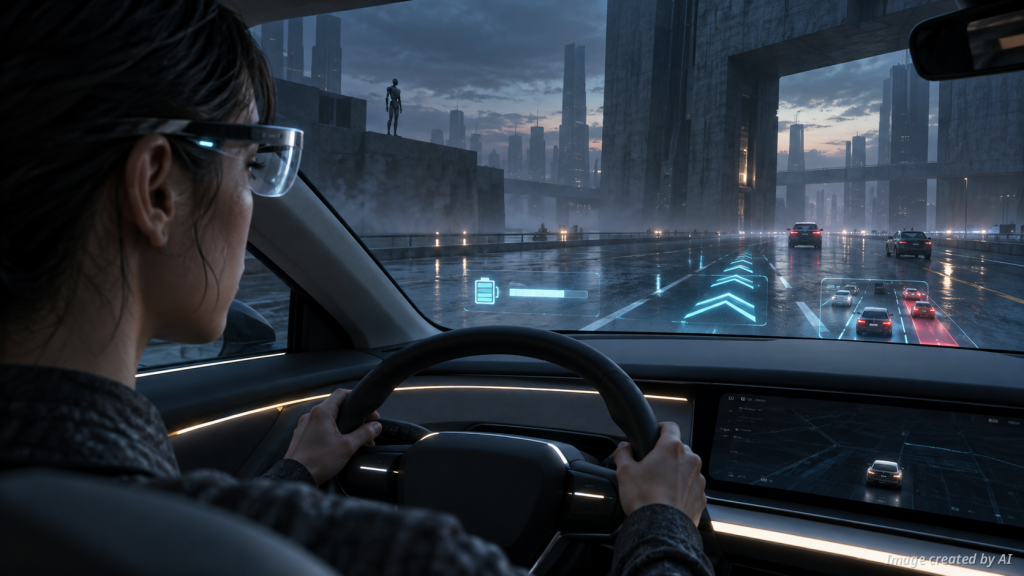
The convergence of automotive and immersive tech
Virtual reality allows engineers to simulate complex environments without physical prototypes. This capability significantly reduces development costs and time-to-market [1]. By using advanced VR platforms, teams can test EV battery placements or cabin ergonomics in a digital space. This process ensures that every component is optimized before the first physical part is ever built.
AR takes this a step further by overlaying digital information onto the real world. During the assembly of EVs, technicians can use AR glasses to view wiring diagrams or safety protocols in real-time. This reduces human error and speeds up manufacturing cycles [4]. It is a practical application that solves real-world manufacturing challenges [1].
Enhancing the electric vehicle user experience
The interior of an electric vehicle is becoming a digital cockpit. Developers are integrating AR into the windshield to provide heads-up displays (HUDs). These displays show navigation, battery status, and traffic alerts directly in the driver's line of sight. This technology keeps the driver focused on the road while providing essential data.
VR is also changing how customers purchase cars. Potential buyers can take a virtual test drive from the comfort of their homes [2]. They can customize colors, interior materials, and battery configurations in a fully immersive VR environment. This personalized experience drives engagement and sales in a competitive market.
Key technical challenges for developers
Developing for AR and VR in the automotive sector requires high-performance computing. Latency is the enemy of immersion. Developers must optimize software to ensure that visual feedback matches physical movement perfectly. If the delay is too high, it leads to motion sickness and poor user adoption [5].
Furthermore, hardware must be lightweight and ergonomic. Users cannot wear heavy, cumbersome headsets for long periods during assembly or driving. The trend is shifting toward compact, comfortable devices that integrate seamlessly into the workflow [1]. Developers must focus on electric vehicles and big data for personalized experiences to ensure that these systems remain responsive and intuitive.
The role of artificial intelligence
AI acts as the brain behind these immersive experiences. It powers the object recognition needed for AR to function accurately. In VR, AI creates dynamic simulations that adapt to user behavior in real-time [1]. This combination of technologies is essential for the future of autonomous driving.
Developers should explore how the role of AI for EV production lines can be combined with AR interfaces. This integration allows for predictive maintenance, where AR highlights potential issues before they cause a breakdown. It is a powerful tool for maintaining the efficiency of electric fleets.
Market outlook and growth potential
The global market for AR and VR is expanding rapidly. By 2025, we expect to see millions of devices in use across various sectors, including automotive [1]. This growth is fueled by the falling cost of hardware and the increasing power of mobile processors [5].
As AR and VR technologies become more accessible, their adoption in the electric vehicle space will accelerate. Developers who master these tools today will be at the forefront of the next industrial revolution. The opportunity to shape the future of mobility is immense [3].
Best practices for AR VR developers
- Prioritize low-latency performance to ensure user comfort and safety.
- Focus on cross-platform compatibility to reach a wider audience.
- Utilize cloud computing to handle heavy rendering tasks off-device.
- Incorporate user feedback loops to refine the interface design.
- Stay updated with the latest sensor fusion technologies for better tracking.
Conclusion
Electric vehicles and AR VR technology are two pillars of modern innovation. Their integration promises to make manufacturing safer, design more efficient, and the driving experience more engaging. For developers, this is a golden era of opportunity. By focusing on performance, usability, and AI integration, you can build solutions that define the next generation of transportation.
More Information
- Virtual reality (VR) [1]: A computer-generated simulation of a three-dimensional environment that can be interacted with in a seemingly real or physical way by a person using special electronic equipment.
- Augmented reality (AR) [2]: An interactive experience of a real-world environment where the objects that reside in the real world are enhanced by computer-generated perceptual information.
- Electric vehicle (EV) [3]: A vehicle that uses one or more electric motors for propulsion, powered by a battery pack that can be charged from an external source of electricity.
- Latency [4]: The delay between an input (such as a head movement) and the corresponding visual output in an AR or VR system, which is critical for preventing motion sickness.
- Sensor fusion [5]: The process of combining sensory data from disparate sources such that the resulting information has less uncertainty than would be possible when these sources were used individually.