Electric vehicle ownership is growing rapidly across the globe. As adoption increases, drivers often encounter the challenge of range anxiety. This term describes the fear of running out of battery power before reaching a destination or charger. Fortunately, artificial intelligence is changing how we manage energy consumption and charging logistics. [1]
Modern vehicles now rely on sophisticated algorithms to provide accurate data. These systems move beyond simple estimations based on battery percentage. They analyze complex variables to ensure you reach your destination with confidence. [4]
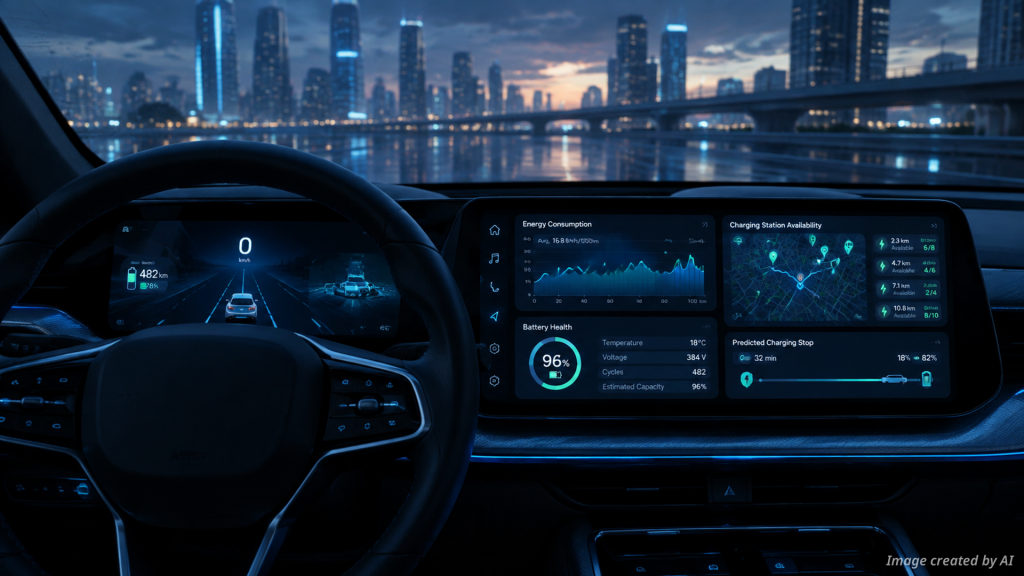
The role of machine learning in energy efficiency
Deep learning methods are becoming the standard for modern range estimation. These models process high-dimensional data that humans cannot easily calculate while driving. By utilizing deep neural networks, vehicles can learn from past driving patterns. [2]
These systems evaluate how specific driving styles impact battery health. They also account for external factors that fluctuate during a trip. Consequently, the accuracy of range prediction has improved significantly under real-world conditions. [4]
External factors and environmental data
Your range is not just about the battery capacity. Environmental variables play a massive role in energy consumption. AI models now integrate weather data and road topology to refine their calculations. [5]
For example, wind speed and direction can alter your range by nearly 50 percent on short journeys. Furthermore, road inclines significantly influence how quickly your battery drains. By choosing routes with fewer hills, drivers can save substantial energy. [5]
Smart algorithms select the most energy-efficient paths for your journey. These systems prioritize routes that balance speed with power conservation. This context aware EV system approach is essential for long-distance travel. [5]
Predicting charging port availability
Range anxiety is often linked to the uncertainty of finding an open charging station. AI helps solve this by predicting the probability of port availability at specific times. Lightweight models can now estimate future occupancy at various locations. [1]
These models use historical data to identify patterns in charging station usage. By understanding the "hour feature weights," the system calculates the likelihood of finding a spot. This reduces the time drivers spend searching for available infrastructure. [1]
You can learn more about reducing range anxiety through these efficient prediction models. When charging networks provide real-time data, AI can optimize your entire trip. This integration is vital for large-scale EV adoption. [3]
Optimizing the charging experience
AI is also integral to "smart charging" initiatives. These algorithms monitor battery health to suggest the best times and locations for a charge. By managing the charging process, they extend the overall life of your battery. [5]
Access to global connector data allows for seamless travel planning. Drivers can filter stations by speed, network, and payment type. This level of detail removes the guesswork from electric vehicle ownership. [3]
For those interested in the broader industry, exploring electric vehicles and the future of gas stations provides context on these shifts. The goal is to make the experience as intuitive as refueling a traditional car. [3]
The future of intelligent mobility
The synergy between machine learning and location data is creating a new standard for drivers. We are moving toward a future where every trip is optimized for energy efficiency. This technology is not just for high-end vehicles; it is becoming a standard feature for all electric models. [3]
As we continue to refine these models, the accuracy of range estimation will only increase. Research indicates that we are already seeing impressive results in real-world testing. This progress is a major win for sustainability and driver convenience. [4]
Stay informed about EV routing and charging optimization to make the most of your vehicle. With AI, you can drive further, charge faster, and enjoy the journey without worry. The era of range anxiety is coming to an end. [3]
More Information
- Range anxiety: A psychological condition where EV drivers fear that their vehicle's battery will run out of power before they reach their destination or a reliable charging station.
- Deep neural networks: A type of artificial intelligence modeled after the human brain that excels at processing complex, high-dimensional data to make accurate predictions for EV energy consumption.
- Smart charging: An intelligent system that uses algorithms to monitor battery status and suggest the most efficient charging times and locations to maximize battery life and range.
- Road topology: The physical characteristics of a road, including inclines, declines, and curves, which significantly affect the amount of energy an electric vehicle consumes during travel.
- Hour feature weights: Learned coefficients in an AI model that quantify the predictable rate of change in charging port availability for every hour of the day.