The automotive industry is undergoing a massive shift toward software-defined vehicles. Embedded systems engineers now face the challenge of integrating complex machine learning models directly into vehicle hardware. This transition to edge AI in electric vehicles (EVs) is not just a trend but a necessity for real-time performance [2].
By moving computation from the cloud to the vehicle, engineers can solve critical latency and privacy issues. This architectural change enables vehicles to make split-second decisions without relying on external connectivity [1]. As we push for higher levels of autonomy and efficiency, edge computing becomes the backbone of modern automotive design.
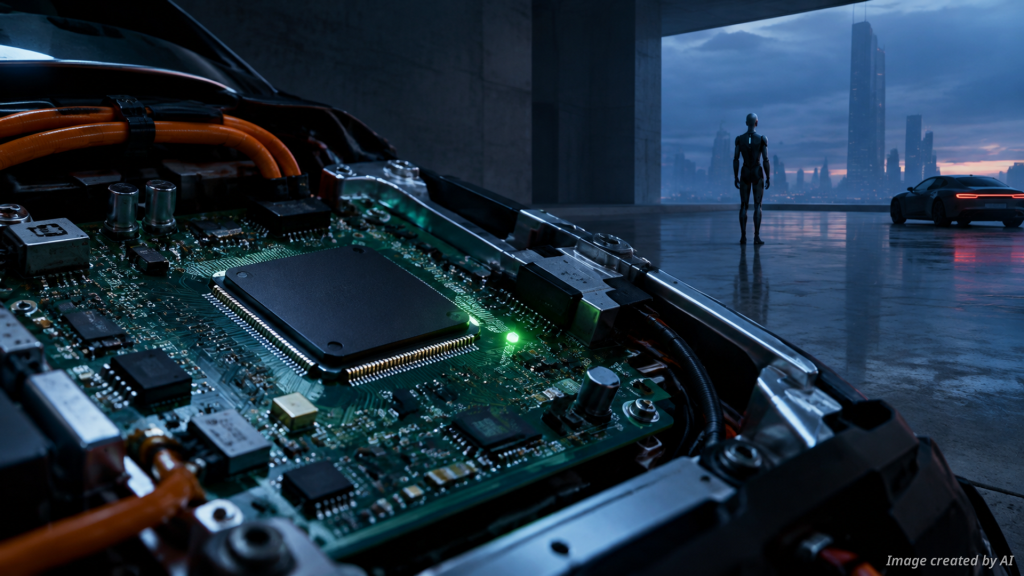
the shift from cloud to edge
Traditional automotive systems often sent sensor data to the cloud for heavy processing. However, this approach introduces significant latency, which is unacceptable for safety-critical applications [1]. Edge AI executes machine learning inference directly on the vehicle's local processor. This approach to edge AI in battery management systems ensures that critical data remains on the device, enhancing security and operational speed.
Engineers must optimize models for low-power hardware while maintaining high accuracy. This requires a deep understanding of neural network quantization and pruning. By leveraging top AI applications in EVs, teams can deploy sophisticated algorithms that operate within the strict thermal and power envelopes of embedded systems.
optimizing battery management systems
Battery management systems (BMS) represent one of the most critical applications for edge AI. Precise state-of-charge (SOC) estimation is vital for range prediction and battery longevity [1]. Instead of relying on static models, edge AI allows the BMS to adapt to individual driving behaviors and environmental conditions in real time.
This dynamic capability helps in predicting thermal runaway before it occurs. By monitoring voltage, current, and temperature at the edge, the system can proactively adjust cooling or power output [2]. This creates a safer, more reliable electric vehicle and smart grid integration, as the vehicle can better manage its energy storage health.
enhancing safety through real-time perception
Autonomous driving relies on the rapid processing of visual and sensor data. Edge AI enables AI for safer and more efficient EVs by reducing the time between detection and reaction [4]. Deep learning models can now identify pedestrians, cyclists, and obstacles with high precision, even in challenging lighting conditions [2].
In-cabin AI is another growing field for embedded engineers. By using local cameras and sensors, the vehicle can monitor driver fatigue or distraction. This immediate feedback loop is only possible when the AI inference happens locally, ensuring privacy and sub-millisecond response times [2].
smart charging and infrastructure
The charging ecosystem is also benefiting from edge intelligence. As EV adoption grows, charging stations face increased pressure to manage energy distribution efficiently [3]. Machine vision integrated into charging stations can identify unauthorized vehicles or optimize the charging sequence based on grid demand [3].
Looking toward 2026, AI will revolutionize EV charging by creating personalized experiences for drivers [5]. For engineers, this means designing systems that can communicate with the grid and the vehicle simultaneously. This interconnected reality requires robust, secure, and intelligent edge hardware capable of running complex optimization algorithms [5].
predictive maintenance and operational uptime
Predictive maintenance is a standout use case for AI in modern transportation [2]. By analyzing telematics data locally, the vehicle can forecast component failures before they lead to a breakdown. This allows for timely maintenance schedules that maximize vehicle uptime [2].
Embedded systems engineers play a key role here by selecting the right sensors and processing power. The goal is to balance the computational load so that the vehicle remains responsive while performing background diagnostics. This proactive approach not only lowers costs for owners but also extends the lifecycle of the vehicle's critical components [2].
future perspectives for embedded engineers
The integration of edge AI in electric vehicles is still in its infancy. As hardware becomes more powerful, we can expect to see even more complex models running on the edge. Engineers must focus on interoperability, security, and energy efficiency to meet the demands of future mobility.
The ability to deploy, update, and manage these models over-the-air (OTA) will define the next generation of automotive software. By mastering the intersection of embedded hardware and machine learning, engineers will drive the next wave of innovation in the EV sector. The road ahead is complex, but the potential for safer, smarter, and more efficient transportation is immense [4].
More Information
- Edge AI: The practice of running machine learning models directly on local hardware rather than in the cloud, enabling real-time decision-making and reduced latency for embedded systems [1].
- Predictive maintenance: A technique that uses data analytics and AI to forecast equipment failures, allowing for repairs to be scheduled before a breakdown occurs, thus maximizing uptime [2].
- Machine vision: A technology that enables computers to interpret and understand visual information from the world, commonly used in EVs for obstacle detection and automated charging station management [3].
- State-of-charge (SOC): An estimation of the remaining capacity of a battery, which is critical for range prediction and is significantly improved by edge AI-driven battery management systems [4].
- Inference: The process of running a trained machine learning model on new data to make predictions or decisions, which is the core function performed by edge AI processors in vehicles [5].