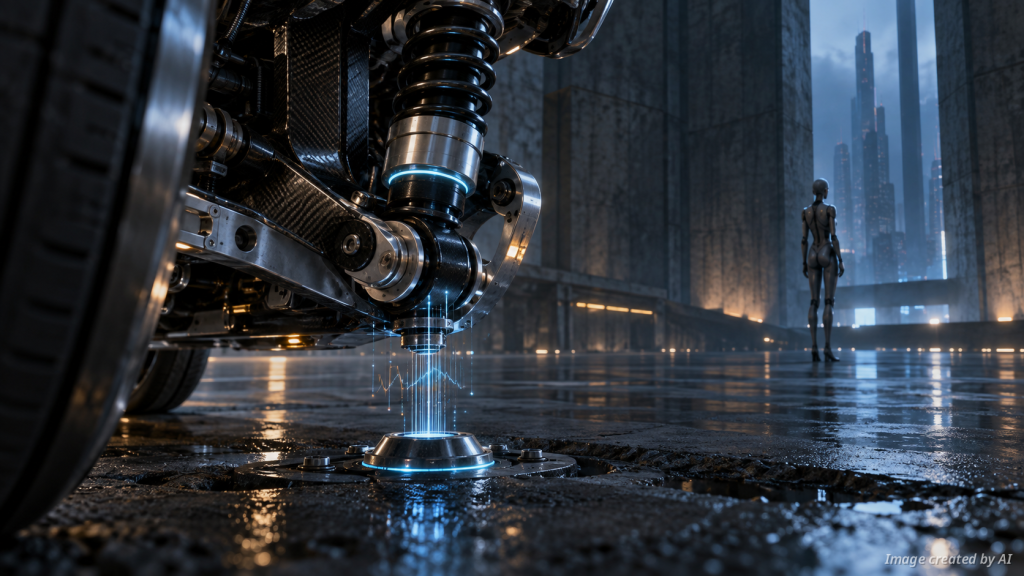
Automotive chassis engineering is undergoing a fundamental shift as artificial intelligence enters the suspension domain. Engineers now leverage machine learning to move beyond static or semi-active damping toward true predictive control. This evolution ensures that vehicles adapt to road conditions before the chassis even encounters a disturbance.
The integration of AI-driven systems is not merely a luxury feature for high-end models. It represents a critical advancement in vehicle stability, passenger comfort, and tire longevity. As manufacturers push for higher levels of autonomy, the suspension system must act as a primary sensor and actuator platform [3].
Market growth and the shift toward intelligence
The global market for adaptive suspension systems is expanding at a rapid pace. By 2030, the industry is projected to reach a valuation of USD 5.6 billion [2]. This growth is driven by a strong consumer preference for superior ride quality and vehicle stability.
Premium vehicle manufacturers are currently leading this trend. Companies like Mercedes-Benz, BMW, and Audi are setting new benchmarks for advanced adaptive suspension technologies to differentiate their platforms [1]. These systems utilize sophisticated AI algorithms to process sensor data in real time.
How adaptive suspension AI functions
At its core, an AI-enhanced suspension system relies on a centralized electronic control unit (ECU). This unit continuously monitors road conditions through an array of sensors, including accelerometers and cameras. The AI then processes this data to adjust damping rates instantaneously [3].
Engineers design these algorithms to distinguish between various road surfaces and driving styles. By employing artificial intelligence supported semi-active suspension systems, manufacturers can optimize the trade-off between comfort and road holding [5]. This precision is vital for maintaining tire contact during high-speed maneuvers.
Performance benefits for chassis engineers
The implementation of AI-assisted chassis control software provides measurable performance gains. OEMs have reported approximately 23% improvement in ride comfort consistency when utilizing these integrated systems [2]. This is particularly noticeable in premium SUVs and performance-oriented vehicles.
Furthermore, AI allows for significant optimization of tire wear. By reducing erratic wheel movements, the system ensures more uniform contact pressure. This contributes to lower maintenance costs and improved safety over the vehicle's lifecycle [2]. For those interested in broader electrification trends, electric vehicles and renewable energy systems are increasingly adopting these chassis technologies to manage the added weight of battery packs.
Future projections and industry impact
The market for adaptive suspension dampers is expected to reach USD 14.1 billion by 2036 [4]. This trajectory suggests that AI-driven road sensing will become a standard feature across most vehicle segments rather than a niche luxury. The rapid innovation in AI adaptive active suspension systems is supported by millions of patent filings globally [3].
Engineers must prepare for a future where the suspension acts as an active participant in vehicle safety. As the rise of AI in autonomous racing demonstrates, the ability to predict and react to track surfaces is a competitive advantage. The same logic applies to consumer vehicles navigating unpredictable urban environments.
Key considerations for implementation
- Sensor fusion: Integrating camera data with vertical acceleration sensors for predictive damping.
- Latency reduction: Ensuring the ECU processes AI inferences within millisecond windows.
- Energy efficiency: Balancing the power consumption of active actuators with overall vehicle range.
- Software modularity: Developing scalable AI models that adapt to different vehicle architectures.
The transition toward intelligent chassis control requires a multidisciplinary approach. Mechanical engineers must collaborate closely with software and data science teams. This synergy is the only way to achieve the precision required for next-generation vehicle dynamics.
More Information
- Adaptive suspension: A system that automatically adjusts the damping characteristics of a vehicle's suspension in real time based on road conditions and driver input to improve handling and comfort [1].
- Damping consistency: The measure of a suspension system's ability to maintain a uniform ride quality across varying road surfaces and driving scenarios, often improved through AI-driven control [2].
- Electronic control unit (ECU): A centralized microprocessor that processes data from various vehicle sensors to manage and optimize the performance of specific subsystems, such as active suspension [3].
- Predictive control: An advanced control strategy that uses AI to anticipate road disturbances before they occur, allowing the suspension to prepare the actuators for optimal response [4].
- Semi-active suspension: A suspension system that can change its damping coefficient in real time but does not actively add energy to the system, often enhanced by AI algorithms [5].