Modern transportation is undergoing a massive transformation. Artificial intelligence (AI) now plays a pivotal role in how we interact with our vehicles. By tracking individual habits, AI systems provide real-time feedback to help drivers become safer and more efficient on the road [4].
Many drivers struggle to identify their own bad habits behind the wheel. Whether it is harsh braking or distracted driving, these behaviors often go unnoticed until a near-miss occurs. Advanced AI-integrated cameras and sensors now act as a digital co-pilot to monitor these patterns [2].
Understanding how AI monitors your driving
AI technology works by collecting vast amounts of data from your vehicle's sensors. These systems track speed, steering inputs, and even the distance between your car and other objects [3]. By processing this information, the AI creates a profile of your unique driving style.
This process is similar to how electric vehicles learn driver behavior to optimize the experience. The software identifies patterns that might lead to accidents. For instance, if you consistently brake too late, the system flags this behavior and suggests a smoother approach [1].
The role of predictive analytics in safety
Safety is the primary goal of integrating AI into modern vehicles. These systems do more than just record data; they predict potential hazards before they happen. By analyzing environmental factors, the AI can warn you about pedestrians or sudden obstacles in your path [3].
This predictive capability is crucial for reducing human error. Many accidents occur because drivers lose focus for a split second. AI-driven monitoring ensures that if your attention drifts, you receive an immediate alert to refocus on the road [2].
Improving efficiency through feedback
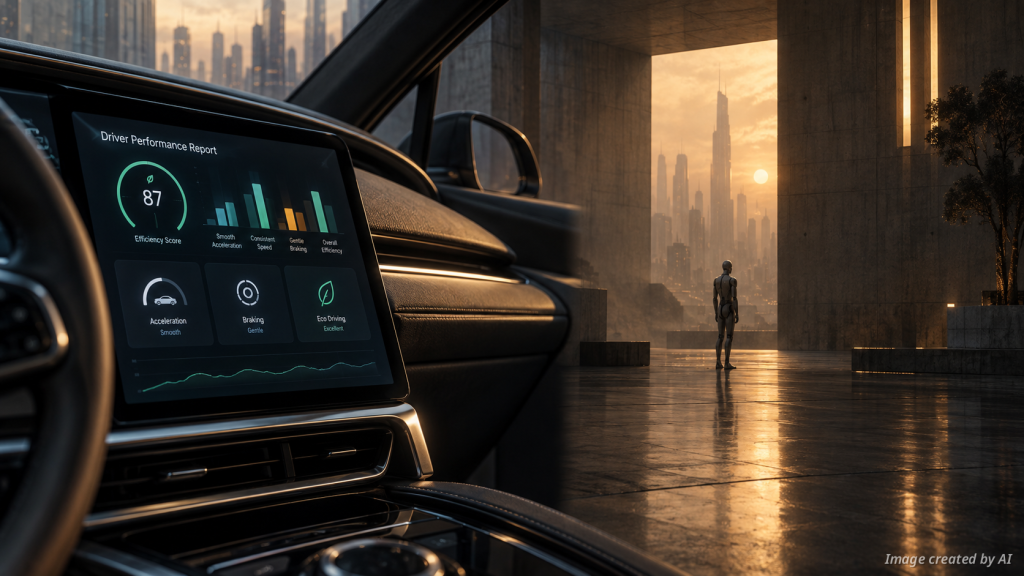
Beyond safety, AI helps you become a more efficient driver. Many systems provide post-trip reports that detail your fuel consumption and acceleration habits. These reports offer actionable advice on how to save energy and reduce wear on your vehicle [4].
For example, the system might suggest accelerating more gradually to improve your vehicle's range. This feature is particularly useful for those who want to use AI driver monitoring systems for maximum road safety while also managing their vehicle's long-term maintenance costs.
The future of autonomous and assisted driving
As we move toward a future with more autonomous vehicles, the role of AI becomes even more prominent. In commercial transport, AI is already being used to manage fleets more effectively [1]. These systems learn from real-world conditions to optimize routes and reduce congestion [4].
Even in personal vehicles, the technology is evolving rapidly. We are seeing a shift where cars act as intelligent partners rather than just machines. As AI capabilities expand, the ability for vehicles to "understand" their drivers will only improve [4].
Addressing the challenges of AI integration
Despite the benefits, there are challenges to consider. Data privacy remains a significant concern for many users. It is essential for manufacturers to ensure that driving data is handled securely [5]. Furthermore, the reliance on technology should not replace the driver's own judgment.
Human intuition is still a critical component of safe driving. The AI should be viewed as a tool for support rather than a replacement for human awareness. By combining human experience with machine precision, we can create a safer environment for everyone on the road [1].
How to start using AI driving assistants
If you want to improve your driving skills today, look for vehicles or aftermarket devices that offer AI-powered driver assistance systems. Many modern cars come equipped with these features as standard. You can also download apps that use your smartphone's sensors to provide similar feedback [5].
Start by reviewing your driving reports after each trip. Pay attention to the specific areas where the AI suggests improvements. Over time, these small adjustments will become second nature, making you a safer and more confident driver.
More Information
- Commercial AI integration: The use of artificial intelligence in commercial transport to analyze driver performance, optimize routes, and improve overall fleet efficiency based on real-world operational data [1].
- ADAS (Advanced Driver Assistance Systems): Technologies integrated into vehicles, such as AI-powered cameras, designed to prevent collisions and assist drivers by providing real-time safety alerts and monitoring [2].
- AI simulation: The process of using 3D environments and advanced sensor data to recreate traffic scenarios, helping manufacturers understand and prevent accidents through virtual testing [3].
- Limited memory AI: A type of artificial intelligence that utilizes historical data over a set period to improve performance, commonly found in self-driving cars and virtual assistants [4].
- Data security in AI: The practice of protecting sensitive information collected by AI systems, especially as vehicle connectivity increases and data storage needs grow globally [5].