The manufacturing landscape is undergoing a massive transformation as the automotive industry shifts toward electric vehicles (EVs). Automation engineers now face the challenge of managing unprecedented complexity in battery, motor, and power electronics assembly. Integrating artificial intelligence (AI) into these workflows is no longer optional; it is a necessity for maintaining competitive efficiency [3].
Modern factories are inundated with rapid changes, ranging from evolving battery chemistries to complex model configurations. By leveraging AI in automotive manufacturing, engineers can move beyond fixed logic. Instead, systems adapt in real-time to inventory shifts and production constraints [3].
Enhancing quality control with neural networks
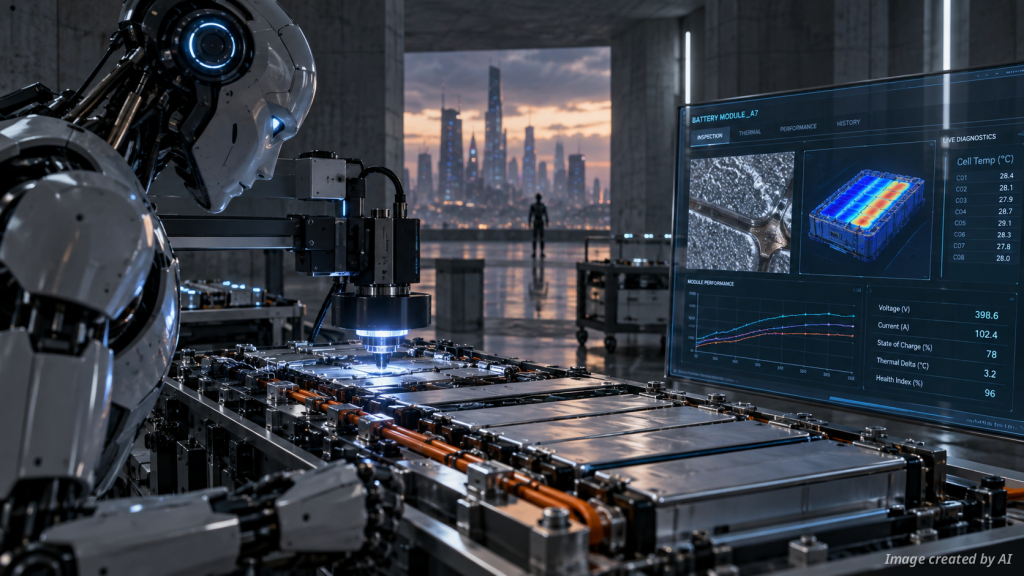
Quality assurance is perhaps the most critical application of AI in the EV sector. Traditional manual inspection often fails to detect microscopic deviations in electrode alignment or material composition. Advanced neural networks now analyze real-time sensor data to identify these flaws before they impact the final product [1].
Companies like BYD have demonstrated the power of this approach by cutting battery defects by 40% through AI-based monitoring [1]. This level of precision is vital, as the battery accounts for a significant portion of the total vehicle cost. By harnessing AI to accelerate production, manufacturers ensure that every unit meets strict safety and performance standards [1].
Digital twins and virtual prototyping
Engineers are increasingly turning to digital twins to optimize their production environments. These virtual replicas allow teams to trial manufacturing runs without the need for extensive physical prototyping [1]. This capability significantly reduces the time required to bring new EV platforms to market.
Furthermore, digital twins facilitate the simulation of various production scenarios. Engineers can fine-tune processes to maximize throughput while minimizing energy consumption. This proactive approach ensures that the role of AI in modern EV battery management systems is mirrored by equally smart production floor logistics.
Scaling automation with machine learning
The convergence of mechanical design and machine learning is the next wave of industrial transformation. Aggressive deployment of AI-guided robotics allows factories to operate with near-total automation [1]. Some facilities now utilize robots capable of autonomous operation, including self-managed battery swapping for 24/7 productivity [2].
For automation engineers, this shift requires a new skill set. The industry is currently transitioning to AI-integrated roles, where data analysis is as important as mechanical maintenance [4]. Mastering these technologies is essential for staying competitive in a global market that values both speed and precision [2].
Predictive maintenance and asset longevity
AI-driven predictive maintenance is changing how we manage factory assets. By analyzing vibration, temperature, and power consumption data, algorithms can predict equipment failure before it occurs [2]. This minimizes downtime and extends the lifespan of critical machinery.
Beyond the factory floor, AI is also being used to project battery lifespan for the end user [4]. This data loop provides manufacturers with valuable insights that inform future research and development [4]. It creates a seamless connection between production quality and long-term vehicle performance.
Optimizing energy and grid coordination
The integration of AI extends to the energy management systems that power these massive manufacturing plants. Advanced algorithms can predict grid loads and optimize energy usage during peak production hours [5]. This is particularly relevant for plants that incorporate renewable energy sources [5].
By analyzing AI techniques for energy efficiency, plants can significantly reduce their carbon footprint [5]. This alignment with sustainability goals is a core requirement for modern automotive manufacturers. It also helps in managing the high-voltage power demands of EV assembly lines effectively [5].
Future-proofing the production line
The transition to EVs is not just a change in product; it is a change in the philosophy of manufacturing. The ability to integrate AI into existing workflows determines which companies will lead the next decade. Engineers must focus on building flexible, data-driven systems that can handle the rapid pace of innovation [3].
If you are interested in the broader implications of these technologies, consider reading about training the workforce for the new electric vehicle industry. Preparing for this future requires a commitment to continuous learning and the adoption of advanced AI tools. Success depends on the ability to bridge the gap between traditional mechanical engineering and modern digital intelligence.
More Information
- Neural networks: A subset of machine learning models inspired by the human brain, used in manufacturing to detect minute irregularities in sensor data that manual inspection might overlook.
- Digital twins: A virtual, real-time representation of a physical production line or process, allowing engineers to simulate and optimize manufacturing runs without risking actual equipment.
- Predictive maintenance: A maintenance strategy that uses AI and sensor data to monitor equipment health, predicting failures before they occur to minimize unplanned downtime.
- Machine learning: A field of AI that enables systems to learn from data patterns, allowing production lines to adapt autonomously to changes in demand or inventory.
- Energy management systems: AI-driven software that monitors and optimizes power consumption within a factory, helping to manage grid loads and integrate renewable energy sources efficiently.